



Artists Beware: The Art of the Con

Today’s topic is an entirely different one than I usually write about, but I feel it’s extremely important to warn other artist’s about the cons of internet scammers. I’ve gotten approached by con artists 3 times now, so it’s time to spread the word.
It makes me so sad that there are people out there trying to take advantage of us artists, as many of us work so ernestly to follow our creative passions and promote them too, often burning the midnight oil to follow our dreams, and just wishing for a sale here and there. I’ve researched this extensively, and all accounts lead us to believe that the creeps come from another country. Many point to Nigeria, where there are con-artist classes that many take, to learn how to cheat westerners out of money and goods. I’m not claiming this as fact, it’s just what I’ve read, and also heard from someone who visited Nigeria. In any case, desperate times lead to desperate measures.
Identifying these creeps is the first step to a dupe-free art sale.
Here are some tell-tale signs, from any potentially scamming email correspondence you may be sent:
1. The grammar is poor.
“meant i reely bad.” You may try to be forgiving at first, but this is usually worse than anyone who’s ever emailed you before. There are many typos, terrible phrasing, missing punctuation, trunicated or run-on sentences, no paragraph returns. Often they address you as “Seller” and not by your first name, and usually don’t even sign their name. Once someone signed their name with a period after it; that may seem like a small thing, but I’ve never seen anyone else do that, have you?
2. They create unusual circumstances around payment.
The first time it happened to me it came through my website, and I didn’t have any other purchase options available yet. I accepted credit card and PayPal, but they wanted to send a check, and then send a messenger to pick up the art. The check arrived a day later, Fed-Ex to my door, for TWICE the amount as requested, and they tried to arrange a pickup immediately that day. But I took it to the bank straight away before doing anything else, and it wouldn’t clear, due to insufficient funds. When I emailed them about it, no response whatsoever. Con. I was mad, but at least relieved that I hadn’t arranged for a pick-up and lost my art to criminals.
I’m not even sure if they were trying to con me out of my art, or they were trying to get me to send back the overdraft of money, but I’ve heard both scenarios played out before. Turns out the person who sent the Fed-Ex had their identity stolen for that Fed-Ex to be sent, the name on the check did not match their alias name, and the company listed on the check does not exist in this country.
The next two times I’d set up an online shop on Etsy by then, I was approached through my Etsy account, by deactivated user accounts no less, who insisted on taking the convo off Etsy immediately, and arranging alternative means of payment. Etsy is so super simple even my tech-challenged parents could figure it out, and it’s very secure purchasing.
3. They claim to be temporarily out of the country, or dealing with major ordeals.
All three times each conner made up some complex story about why they couldn’t go thru standard shipping channels: they’re out of the country, for business, a wedding, or even a family death (to really get your sympathy), they’re pregnant, moving into a new house, buying it for a family member (very unlikely for a large art purchase), but whatever it is, they’re going to create an urgent situation in which they need to send an agent to pick it up, possibly even to bring it to a shipping crate. Really, they’re just trying to pick up the art as fast as possible before the payment clears.
Even if a legitimate buyer wants to pick up the art instead of shipping it, do not give out your home or studio address to strangers, and do not arrange for special pick-ups until after the payment has cleared.
4. They never provide a phone number or address.
Would you, if you didn’t want to be caught? Usually if a legitimate interest has special circumstances, there is no reason for them not to provide a number that you can speak to them at. Sometimes they may provide an address, or company name, but if you trace that information online, you often fine those are bogus or stolen too.
5. There is rarely a reference to your art specifically.
Each time someone is interested in my paintings I like to know why. If I ask and there is no response to that, that is a huge tell-tale sign that they don’t really care about the art, and hence, not a real sale. Often they don’t even refer to the painting by it’s name either, and there is no emotional connection stated. If a real person wants to buy your art, it’s often because they have a emotional response to it, and they would refer to that in some specific way, especially after several detailed correspondences.
6. And finally, when you insist on proper channels, you never hear from them again.
If they’re internet-savvy enough to surf the web and find your art, they are smart enough to figure out purchasing, especially through trusted channels such as Etsy, Fine Art America, and Paypal links from any secure shopping cart. You MUST insist on these forms of payments, and a serious buyer has no issue with that. If they balk, and you say it’s your strict policy, as someone has tried to con you in the past, you’ll never hear from the conner after that. Once you name the game, they know it’s over for them.
As a final note to my fellow artists:
I know how much work you put into your art, and even more into the marketing. I know you how badly you want to make that sale. I know you’re a kind sensitive person, who may give people the benefit of the doubt to do so. However, you can’t let your eagerness to make a sale cloud your better judgement. When people really want your art, the process is usually smooth and easy. It’s just a matter of time, so wait for the right people to come along.
The con is up. Please spread the word to every artist you know.
Attached are some examples of the chains of email correspondences I’ve had in the past, to help illustrate.
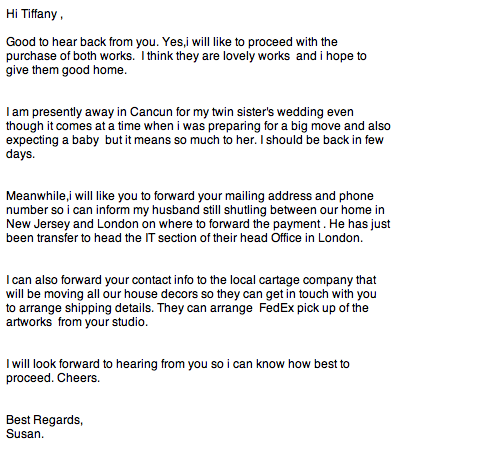
2nd email from alias "Susan Short"
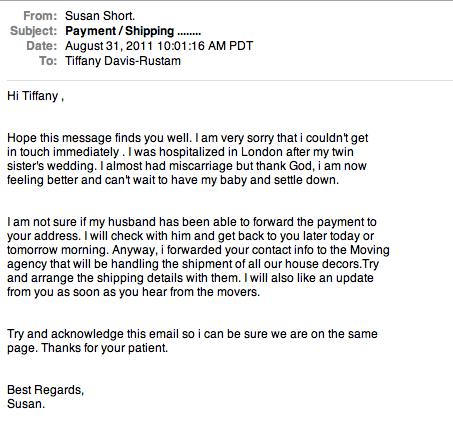
3rd email from alias "Susan Short"
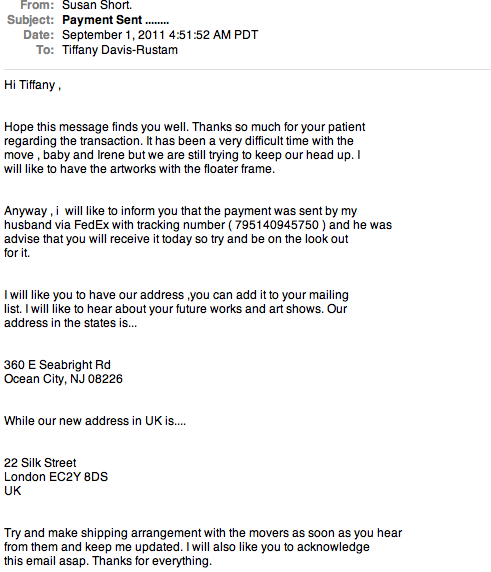
5th email from alias "Susan Short"
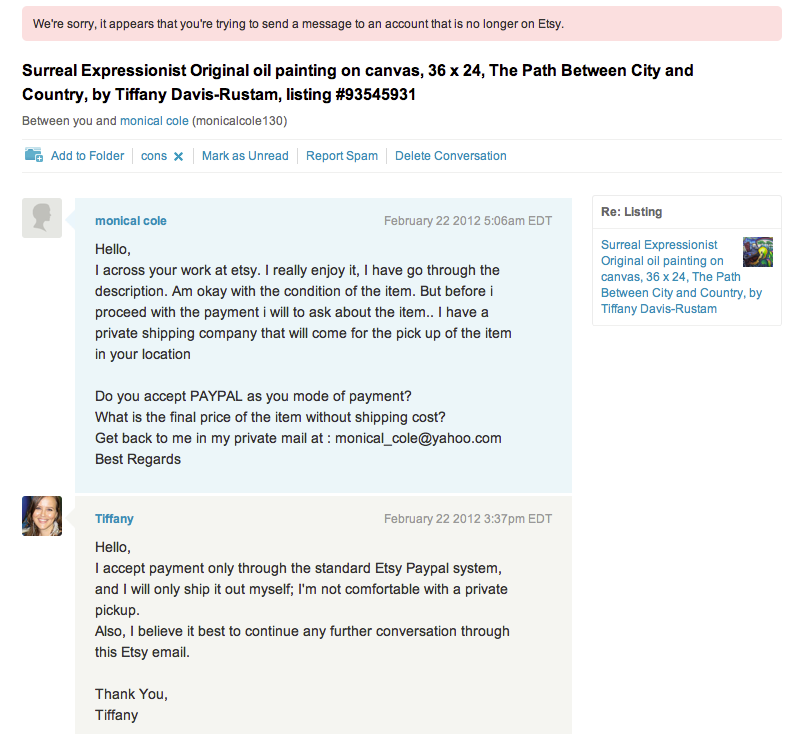
1-time only Etsy message correspondence from alias "Monical Cole"
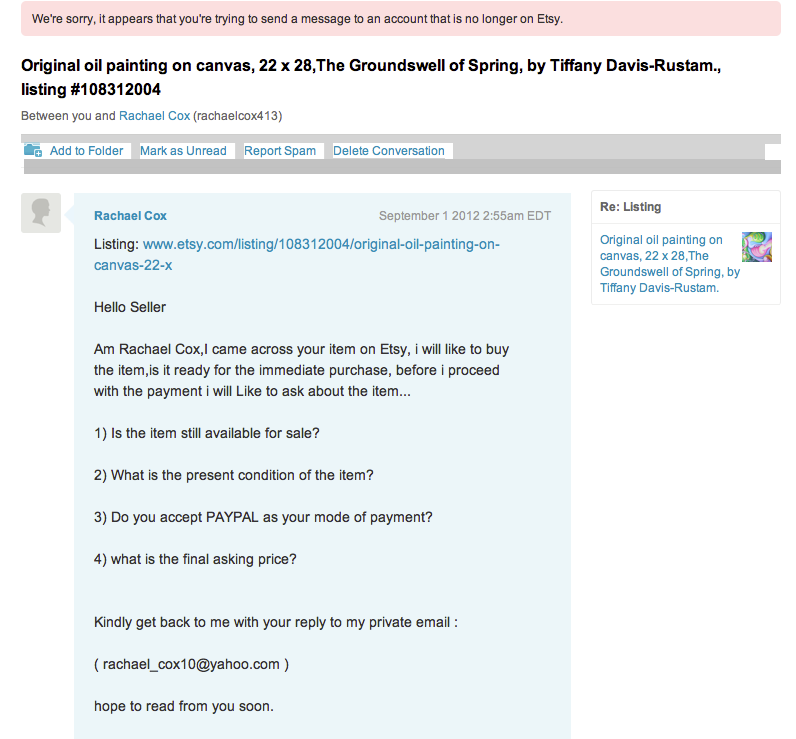
1st Etsy message correspondence from alias "Rachael Cox"
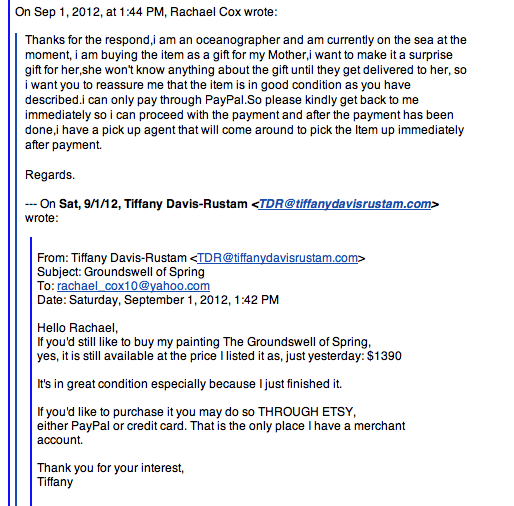
2nd email correspondence from alias "Rachael Cox"
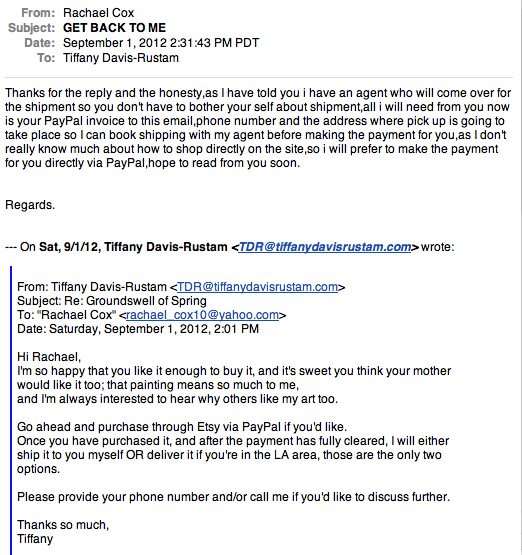
3rd and last email from alias "Rachael Cox"

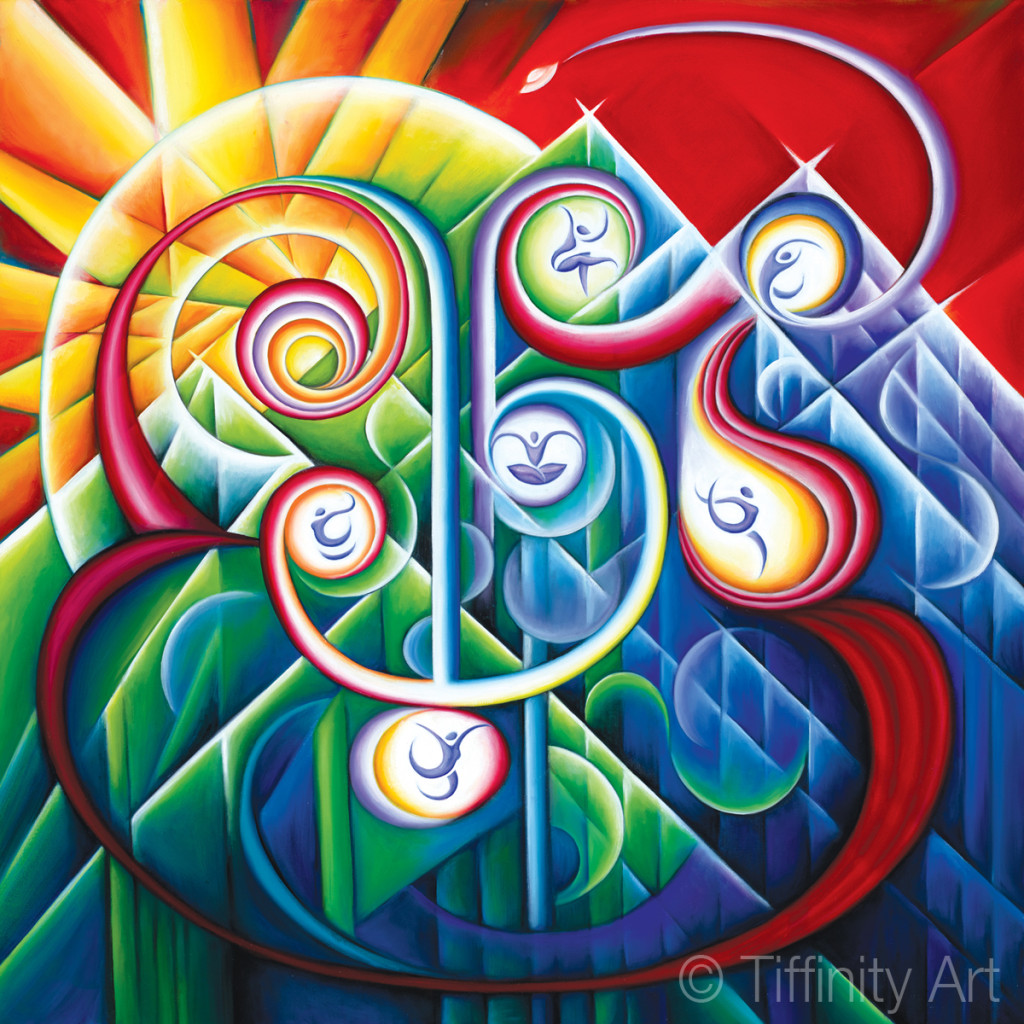
 Tiff
Tiff 


 Loading ...